
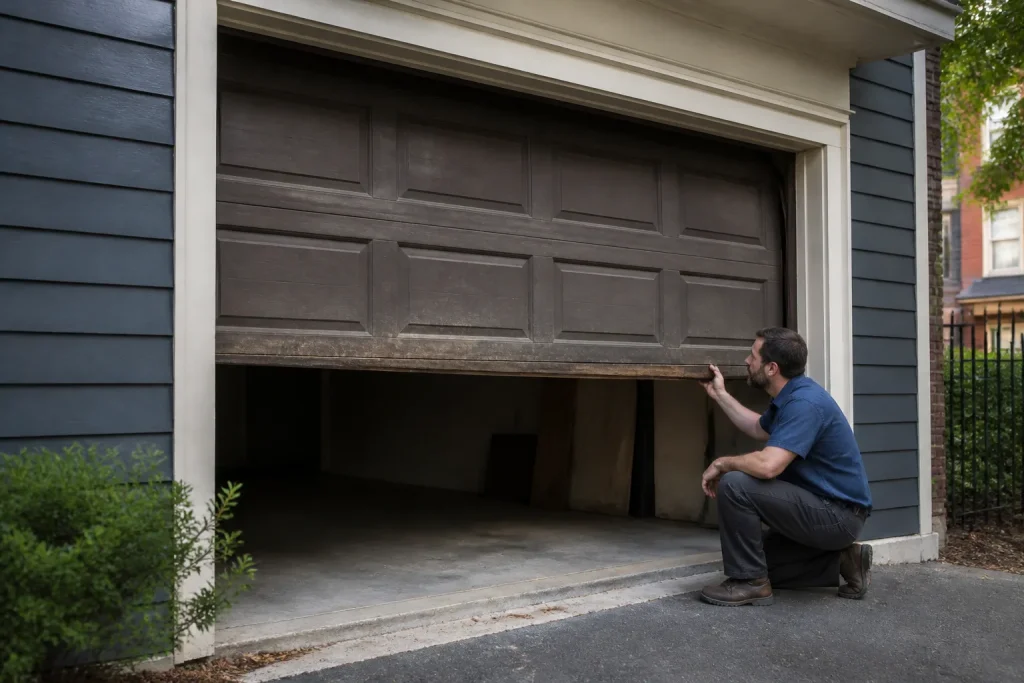
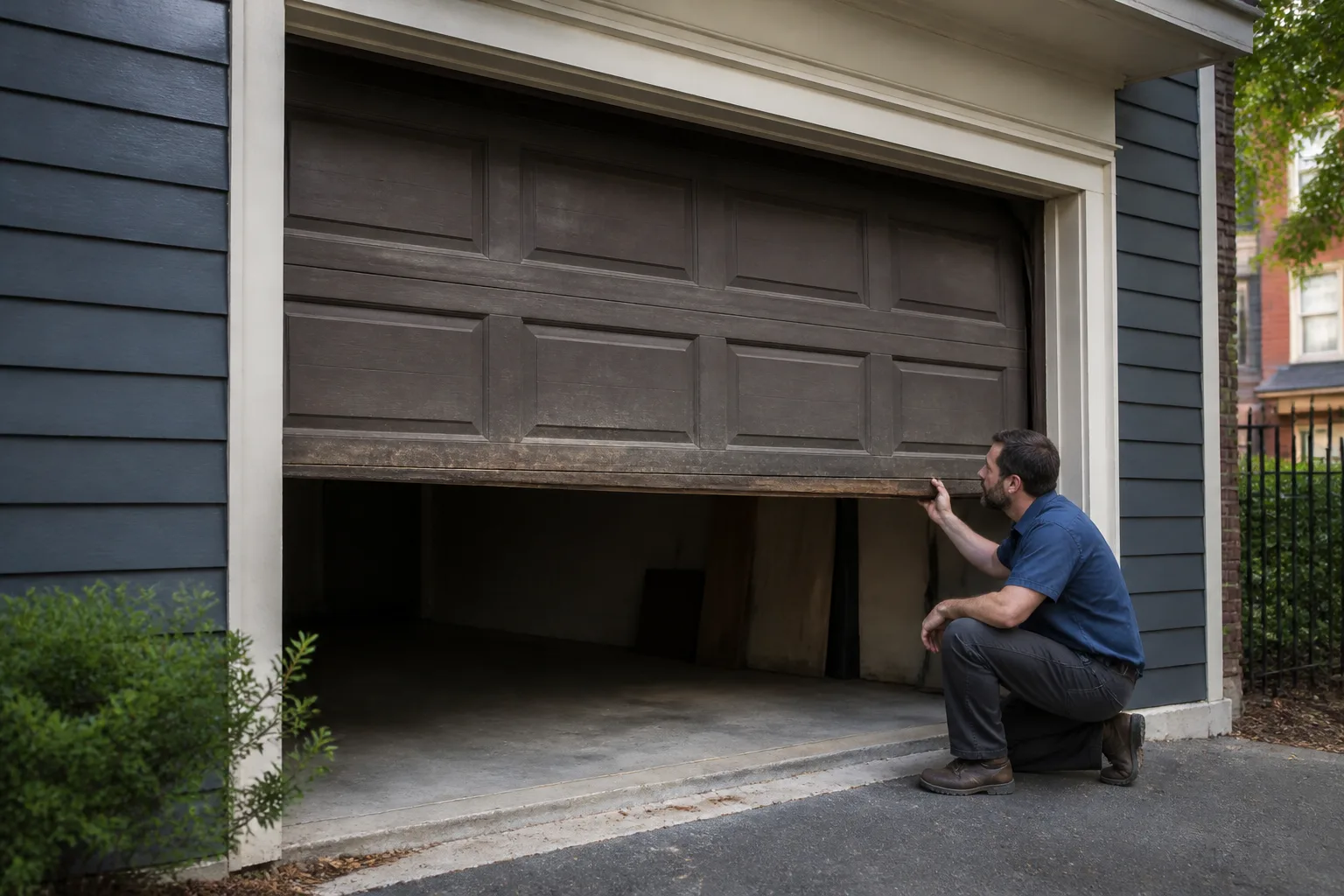
Top Signs You Need Garage Door Service – Don’t Ignore These
Most garage door failures announce themselves weeks ahead of time. The trouble is that the announcement is quiet: an extra second of travel, a shudder at the same point every morning, a little more noise than last winter. The signs that mean you need garage door repair in Jamaica Plain are rarely sudden. They build slowly and they’re easy to write off as “it still works fine.” If you’d rather not climb a ladder to investigate, call (833) 468-3616.
A garage door that takes three seconds longer to open than it did last spring isn’t aging gracefully. It’s telling you the spring tension is off and the opener motor is compensating. That overwork has a predictable endpoint, and it usually arrives on a cold morning when you’re already late.
What Are the Four Performance Warning Signs Most Homeowners Miss?
The four signs that matter most are increased cycle time, hesitation at the same point in travel, asymmetric movement where one side leads the other, and loud operation from a system that used to be quiet. None of these show up on a visual inspection. All four point to a mechanical problem that’s already underway.
1. Increased cycle time
Time your door with a stopwatch, or just count. A door that used to open in twelve seconds and now takes fifteen is fighting added resistance. The spring has lost tension, the track has drifted, or a roller has seized. The opener motor covers for all three by drawing more current, and that extra work shortens the motor’s life.
2. Hesitation at the same point
Watch the door mid-travel. If it stutters at the same height every time, something is binding at that spot: a bent track section, a worn hinge, or a roller that’s flat-spotted. Random hesitation is usually a logic or safety-sensor problem. Repeatable hesitation is mechanical.
3. Asymmetric movement
Stand back and watch both edges of the door. One side leading or lagging means the torsion system is unbalanced or a cable has stretched. On a two-spring setup, a single tired spring causes exactly this. Left alone, the load shifts onto the good spring, and now you’re replacing a pair.
4. Unusually loud operation
A screw-drive Genie or a belt-driven opener should be nearly silent. Grinding, popping, or a metallic scrape is metal-on-metal contact, and it doesn’t fix itself. In our experience, noise complaints often trace back to dry rollers and loose hardware, both quick fixes when caught early.
What Visual Signs Should Jamaica Plain Homeowners Check For?
Jamaica Plain’s winters do specific damage to garage door hardware: freeze-thaw cycles, road salt tracked in on tires, and months of wet, cold air on steel. Rust striping on torsion spring coils is the first thing to look for, followed by cable fraying near the drum and a cracked bottom seal that lets cold air and water under the door.
- Rust striping on spring coils. Orange-red lines along a torsion spring mean the coating has failed. Rust pits the wire and creates a stress point where the spring can break.
- Frayed cable near the drum. Look for broken strands or a cable that’s jumped its groove. A frayed cable is a snapped cable waiting to happen, and it’s a genuine safety issue.
- Cracked or hardened bottom seal. A split seal lets meltwater freeze under the door and wicks cold air into the garage. It’s a cheap part and an easy replacement.
- Bent or misaligned track. Look down the track from the doorway. Any visible kink means the rollers are wearing unevenly on every cycle.
- Loose hinges and brackets. Grab a hinge and wiggle it. Movement means the fasteners have backed out, and that vibration travels into the whole door.
Springs and cables are the two components we tell homeowners never to touch. A torsion spring under load stores enough energy to cause serious injury, and a cable under tension can whip when it releases. Visual inspection from the floor is fine. Adjustment and replacement belong to a trained technician. Clopay and Amarr doors use the same spring and cable architecture underneath, so the risk is universal.
Why Is “It Still Opens” a Dangerous Way to Think?
“It still opens” ignores how a torsion spring fails. A weakened spring doesn’t gradually slow down and stop; it loses tension unevenly, develops a fatigue crack, and lets go mid-cycle. When that happens, the door drops with nothing holding it up. A standard single-car door weighs well over a hundred pounds, and a double-car door can approach three hundred. Without a working spring, that weight is immovable by hand.
The sequence looks like this. First, the spring loses tension and the opener compensates. Then the motor runs hotter and the door travels slower. Then one morning the spring breaks with the door halfway up, and the opener strains against dead weight. Sometimes the door comes down hard. Sometimes the opener’s gear strips and the door hangs where it stopped.
None of that is hypothetical. It’s the standard failure path, and every step gives you a chance to catch it before the last one. A door that still opens is not a door that’s fine. It’s a door that hasn’t failed yet.
How Do You Do the Balance Test, and What Counts as a Pass?
The balance test checks whether your springs are carrying the door’s weight correctly. Disconnect the opener first using the manual release cord, then lift the door by hand to about waist height and let go. A balanced door stays put or drifts less than a foot. A door that drops fast has weak springs. Run this test twice a year, in spring and fall, and always with the opener disconnected.
What the results mean:
- Door holds its position: springs are balanced. Nothing to do.
- Door drifts slowly down: mild tension loss. Worth a look before winter.
- Door drops quickly: springs are seriously weakened. Stop using the opener and get it checked.
- Door rises on its own: springs are over-tensioned, which is just as hard on the opener.
If the door won’t lift by hand at all, don’t force it. That’s a spring or cable problem, and the door should stay down until a technician sees it. If you run the test on a Jamaica Plain door and it fails any of these checks, that’s the moment to call rather than the moment to keep pressing the remote. If you’re not comfortable lifting the door by hand, skip the test and have someone check the springs, cables, and rollers directly.
How Does a Small Seal or Track Problem Turn Into Structural Damage?
A cracked bottom seal or a track that’s off by half an inch compounds fast, especially on the older detached garages common around Jamaica Plain. Water gets in, freezes, and the damage moves from the seal to the door panel to the framing.
Here’s the sequence. A split bottom seal lets snowmelt pool under the door. That water freezes overnight and expands, lifting the door slightly and stressing the bottom panel. Repeated cycles crack the panel’s paint and let moisture into the wood or steel core. Meanwhile, a misaligned track makes the rollers wear unevenly, which puts sideways pressure on the door panels. Over a season, the panels bow and the whole door sits crooked in the opening.
On an attached garage, that same water finds its way into the wall framing between the garage and the house. On a detached garage, the door frame and sill take the hit. Either way, a fifteen-dollar seal replaced early saves a panel replacement later. Wayne Dalton and other panel doors are especially unforgiving once the bottom section warps, because the panels above inherit the misalignment.
When Should You Call a Pro Instead of Watching and Waiting?
Call a professional the moment you see a broken spring, a frayed cable, or a door that won’t stay balanced. Those are the three signs that carry real injury risk and real property damage risk. Everything else can wait a few days, but none of it improves on its own.
The signs that warrant a call:
- A snapped spring, or a door that won’t lift by hand.
- A cable that’s frayed, slack, or off its drum.
- A door that reverses, stops, or won’t close all the way.
- A loud bang from the garage with the door still down.
- Visible track damage or a door sitting crooked in the frame.
Our technicians have up to 9 years of experience, and we work on the brand you already own, whether that’s a LiftMaster opener, a Chamberlain unit, or a Genie drive that’s been in the ceiling since the house was built. We handle diagnosis, parts, and repair without sending you to a second vendor, and we quote the price and get your agreement before any work starts. If the opener is the problem rather than the door, that’s a separate job entirely.
Related services in Jamaica Plain: if the issue traces to the motor, sensors, or remote rather than the door itself, our garage door opener repair team can diagnose it. If the door is past saving, garage door installation is the next step. For general questions or to book a visit, start at Garage Door Repair Jamaica Plain.
The Bottom Line
The warning signs are rarely subtle; they’re just easy to rationalize. Slow travel, hesitation at a fixed point, one side leading the other, and new noise all point to the same underlying wear. Add rust on the springs, frayed cables, and a hardened bottom seal, and you have a clear picture of a door that needs attention before it fails on its own schedule.
Run the balance test twice a year. Watch the door, not just the remote. And when something looks off, treat it as a mechanical signal rather than a personality quirk. That’s the difference between a repair and a replacement.
If you’re in Jamaica Plain and need help, Garage Door Repair Jamaica Plain offers free estimates. Call (833) 468-3616. We answer 24/7. Fast dispatch from 7am to 7pm, Sunday through Friday.
Frequently Asked Questions
Watch for rust striping on the coils and a door that’s gotten noticeably heavier to lift by hand. A spring that’s losing tension often shows a visible gap or a slight bow before it snaps. Any of those signs means you should stop using the door.
No. A torsion spring stores enough energy to cause severe injury, and a released cable can whip. This is one of the most dangerous jobs in the trade and belongs to a trained technician with the right tools.
Twice a year, ideally in spring and fall. Disconnect the opener, lift the door to waist height, and let go. A door that holds or drifts less than a foot is balanced. Anything else needs a look.
Not always, but new noise from a system that used to be quiet usually is. Grinding, popping, or scraping points to worn rollers, loose hardware, or metal-on-metal contact. Have it diagnosed before it turns into a bigger repair.
Written by the team at Garage Door Repair Jamaica Plain.
Need Garage Door Help?
Call Garage Door Repair Jamaica Plain - the local pro we connect you with is licensed and insured, here with fast help in Jamaica Plain.
(833) 468-3616